Car Depreciation Explained: What's Your Car Worth Now?
Understand your car's value to take control of your auto loan
By Dori Zinn
5 min. read
What is Car Depreciation?
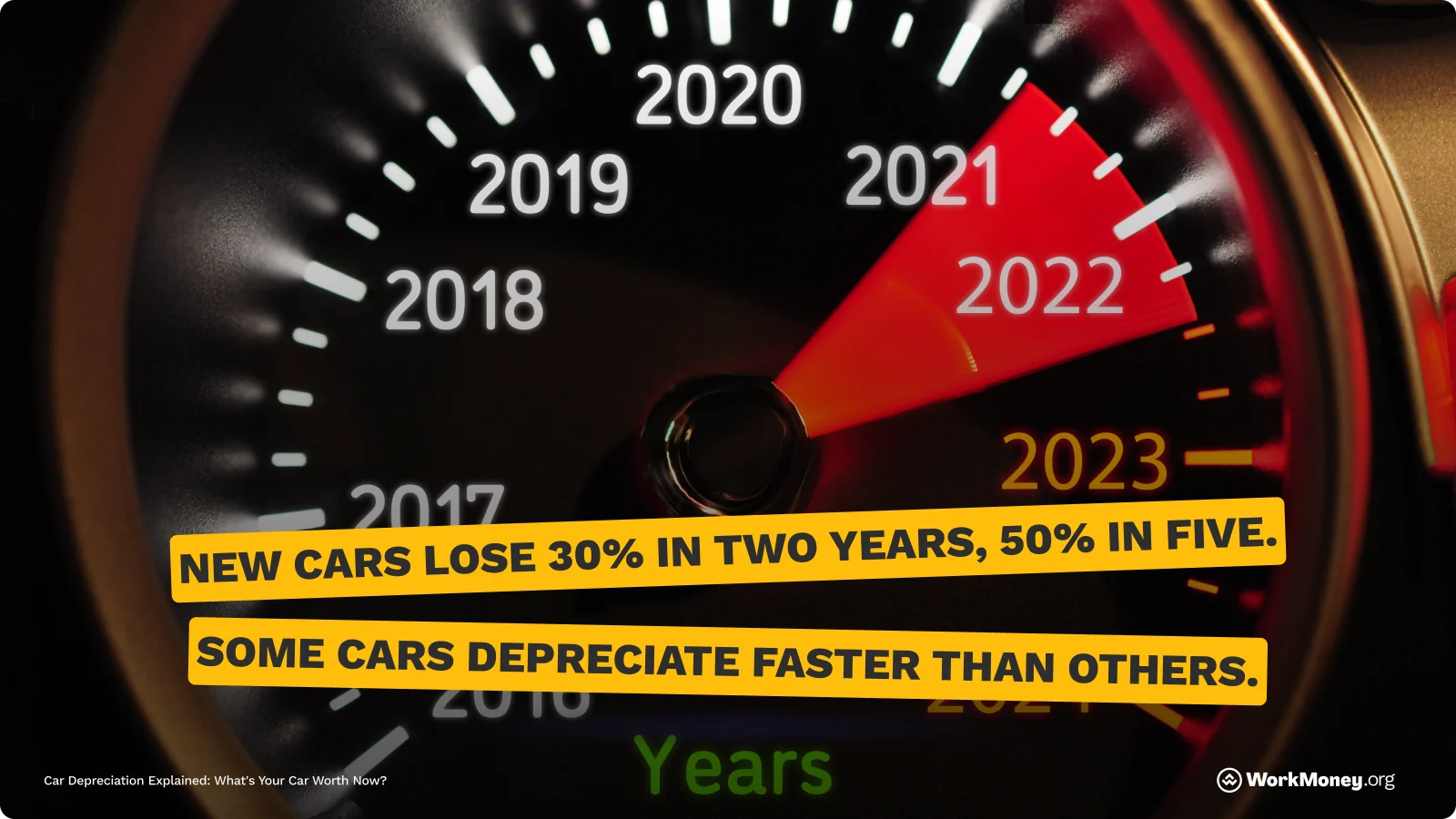
Car depreciation is what happens when your car loses value. According to Kelley Blue Book, new vehicles lose 30% in the first two years of ownership and more than half their purchase price in the first five years of car ownership.
Depreciation comes from the age of your car, mileage, everyday wear, and market conditions. Because of depreciation, what you spent on your car is nowhere near what you’ll get back when it comes time to resell or trade it in at the dealership.
Why Does Car Depreciation Matter?
Car depreciation is the most significant cost when owning a car. What you pay for your vehicle when you buy it is vastly different compared to its value one, three, or five years later. For instance, spending $45,000 on a car will likely be worth $37,800 a year later.
Car Depreciation and Going “Underwater”
Your car will depreciate, but the rate at which it depreciates depends on the vehicle you have and a few other factors. While you could pay cash for your car, many finance it with an auto loan. According to Experian, financing pays for 80% of new car purchases. For used vehicles, 37% of buyers take out a car loan. For leasing, 23% use financing.
Even though the value of your car goes down with depreciation, your auto payments stay the same. Say you bought a $45,000 car with a $10,000 down payment and you’re financing the remaining $35,000. After five years — a 60-month term — you’ll end up paying $39,629.59 with interest. At the same time, your car will now be worth $20,250. By the end of your loan, your car’s value will drop to about half of what you paid for it, on average.
When you owe more on your car than it’s worth, you go underwater on your car loan. Getting out of a car loan you’re underwater on isn't easy. You’ll have negative equity, meaning you’re upside-down on your auto loan. This isn’t a great financial situation, but you can escape it by paying your car loan faster.
What Causes Car Depreciation?
There are a few different factors that impact your car’s depreciation, including:
Condition: Putting wear and tear on your car is normal, but it increases your car’s depreciation.
Mileage: Most cars drive anywhere from 12,000 to 15,000 miles per year. If you’re driving more than that, your car might depreciate faster than someone driving less.
Service history: Staying on top of your car’s maintenance schedule keeps it from experiencing unexpected (and expensive) issues later. Maintaining your car through regular service appointments helps hold its value, while missing service could depreciate it faster.
Demand: The type of car you have impacts its depreciation. If you have a car in higher demand than others, the depreciation of that car is slower than that of cars that aren’t in demand.
Warranties: Vehicles with active warranties appeal more to potential buyers than cars that don’t, slowing depreciation. Warranties transfer with ownership, so if something happens to it, buyers want the peace of mind that a warranty covers it.
Cars That Depreciate the Fastest (and Slowest)
Some cars depreciate much faster than others — even if used the same way.
Fastest-Depreciating Cars | Slowest-Depreciating Cars |
|---|---|
1. Jaguar I-PACE Average 5-Year Depreciation: 72.2% Average Difference from MSRP: $51,953 | 1. Porsche 911 Average 5-Year Depreciation: 19.5% Average Difference from MSRP: $24,428 |
2. BMW 7 Series Average 5-Year Depreciation: 67.1% Average Difference from MSRP: $65,249 | 2. Porsche 718 Cayman Average 5-Year Depreciation: 21.8% Average Difference from MSRP: $15,851 |
3. Tesla Model S Average 5-Year Depreciation: 65.2% Average Difference from MSRP: $52,165 | 3. Toyota Tacoma Average 5-Year Depreciation: 26.0% Average Difference from MSRP: $8,217 |
4. INFINITI QX80 Average 5-Year Depreciation: 65.0% Average Difference from MSRP: $53,571 | 4. Chevrolet Corvette Average 5-Year Depreciation: 27.2% Average Difference from MSRP: $18,557 |
5. Maserati Ghibli Average 5-Year Depreciation: 64.7% Average Difference from MSRP: $70,874 | 5. Honda Civic Average 5-Year Depreciation: 28.0% Average Difference from MSRP: $6,987 |
How Depreciation Impacts Car-Buying
Before you head to the dealership or sign the paperwork for buying a car, determine how much your potential car could depreciate in the next few years.
Look for cars with a slow depreciating rate that can hold most of their value after five years of ownership. Since vehicles depreciate at varying rates, browse options in your budget that hold their value for longer.
You may want to buy a used car, which typically depreciates less than new cars, mainly since they’ve already lost most of their value. If possible, make a larger down payment when buying a car to avoid taking out an auto loan that’s more expensive to pay off.
When you trade in the car you currently owe money on, that loan gets rolled into your new car loan, and you’ll make larger monthly payments to account for your new and old car. This might be harder to afford when you have larger monthly payments.
The Bottom Line
Every car owner faces depreciation with their vehicle. It’s normal to see your car lose some of its value, but not every vehicle loses the same amount or at the same rate as others. If you’re buying a car, check its expected depreciation to see what you can expect to lose while owning it.
See your car's worth before selling it or trading it in. This will help you figure out future car payments on your next vehicle and how much car you can afford.
Was this information helpful?
About the Author

Dori Zinn
Dori Zinn is a longtime personal finance journalist with nearly 20 years of experience in digital media. Her work has been featured in the New York Times, Wall Street Journal, CBS News, Yahoo, CNN, USA Today, and more. She loves helping folks learn about money. If she isn’t writing, she’s reading, baking, or watching football.