WorkMoney
  • Save MoneyOn food, bills, and everyday expenses
    Save MoneyOn food, bills, and everyday expensesExplore
    • Food
    • Utilities
    • Housing
    • Healthcare
    • Transportation
  • Take ControlCreate budgets, pay debt & build your safety net
    Take ControlCreate budgets, pay debt & build your safety netExplore
    • Budgeting
    • Credit
    • Debt
    • Savings
    • Work
    • Taxes
  • Plan AheadFor retirement, big purchases, and your goals
    Plan AheadFor retirement, big purchases, and your goalsExplore
    • Insurance
    • Homeownership
    • Investing
    • Retirement
    • Life Events
  • Member Benefits
  • About Us

Searching…

Sign up
DonateSign up

Searching…

  • Save MoneyOn food, bills, and everyday expenses
    Save MoneyOn food, bills, and everyday expensesExplore
    • Food
    • Utilities
    • Housing
    • Healthcare
    • Transportation
  • Take ControlCreate budgets, pay debt & build your safety net
    Take ControlCreate budgets, pay debt & build your safety netExplore
    • Budgeting
    • Credit
    • Debt
    • Savings
    • Work
    • Taxes
  • Plan AheadFor retirement, big purchases, and your goals
    Plan AheadFor retirement, big purchases, and your goalsExplore
    • Insurance
    • Homeownership
    • Investing
    • Retirement
    • Life Events
  • Member Benefits
  • About Us
DonateSign up
The Joy of Money book by Carrie Joy Grimes

You don’t have to figure money out alone

Get clear, practical guidance and real-life insights from our CEO, Carrie Joy Grimes, in her new bestseller, The Joy of Money.

Learn more
WorkMoney

About Us

  • Careers
  • Contact Us
  • Frequently Asked Questions
  • In the News

Save Money

  • Food
  • Utilities
  • Housing
  • Healthcare
  • Transportation

Take Control

  • Budgeting
  • Credit
  • Debt Management
  • Savings
  • Work & Income
  • Taxes

Plan Ahead

  • Insurance
  • Home Ownership
  • Investing
  • Retirement
  • Major Life Events

Resources

  • Articles
  • The Joy of Money

Membership

  • Member Benefits
  • Member Testimonials
  • Member Login
  • Sign Up

  • Privacy Policy
  • Terms
  • SMS Terms of Service
  • Product Terms
  • Site Map

  • English
  • Español
© 2026– WorkMoney
  1. Home
  2. How to Lower Your Medical Bills

Key takeaways

✔️ Review bills before paying: Request an itemized bill, check for errors, and negotiate if needed.

✔️ Ask for cost estimates: Under the No Surprises Act, you’re entitled to a good-faith estimate for non-emergency care.

✔️ Appeal insurance denials: 20% of claims are denied, but most aren’t appealed—challenge them to lower your costs.

✔️ Explore debt forgiveness: Nonprofit hospitals offer charity care; organizations like Dollar For can help you apply.

If you feel anxious every time you check the mail, you’re not the only one. Nearly 14 million people in the U.S. have over $1,000 in medical debt, and about 3 million owe more than $10,000. Even among those over age 65 and covered by Medicare, more than one in five adults ages 65 and older are struggling with medical debt. And let's be real– no one should have to choose between groceries and medical bills.

WorkMoney wants to help you wrangle your medical bills and potentially find some relief.
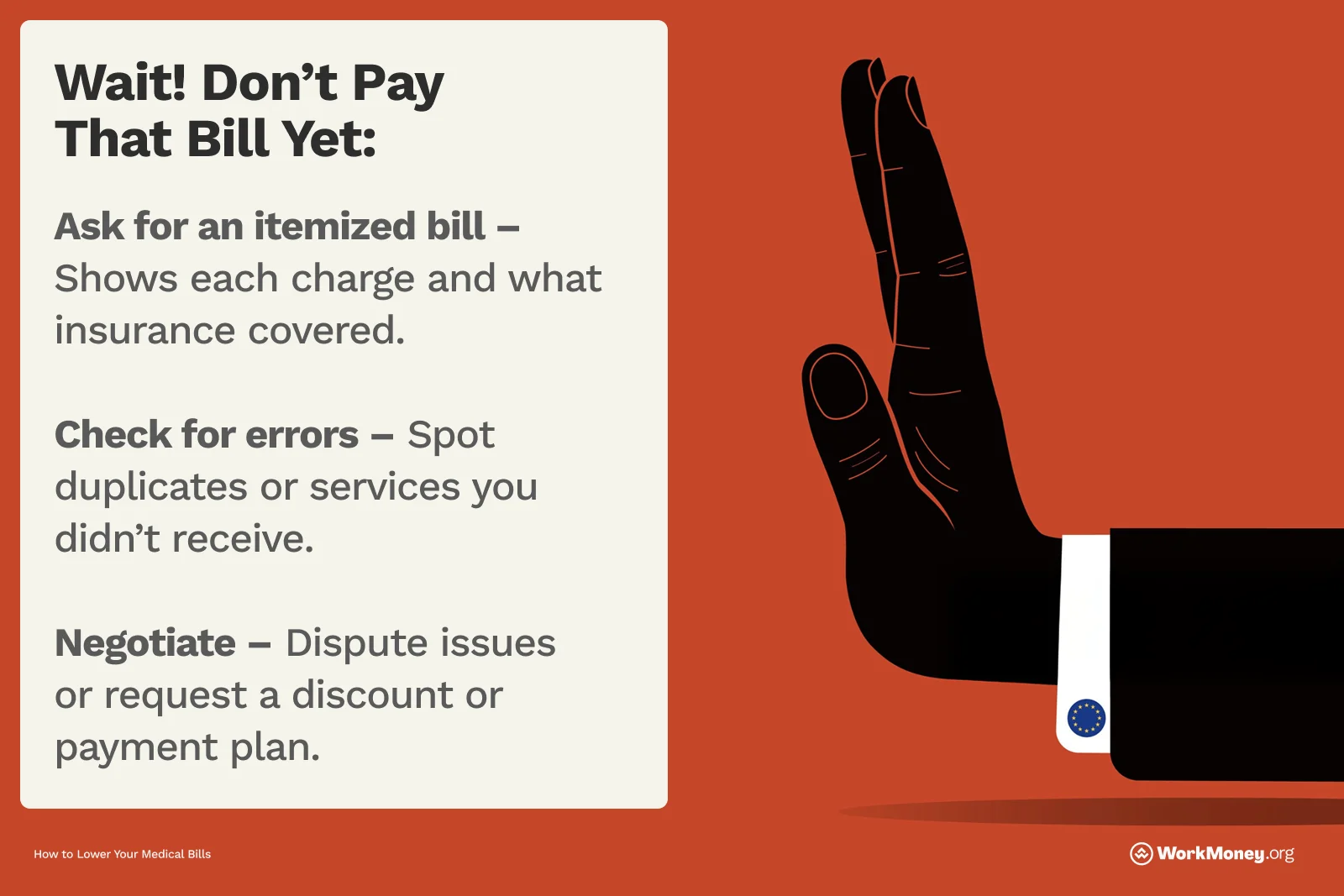
 Illustration of a raised hand signaling "stop" next to a checklist titled “Wait! Don’t Pay That Bill Yet.” Tips include: ask for an itemized bill, check for errors, and negotiate. The image promotes strategies for lowering medical bills. Branding from WorkMoney.org is present.

Being Proactive about Your Healthcare Costs

When you're planning for non-emergency surgeries or treatments, it's totally okay to chat with your provider ahead of time. Think about it like getting an estimate for a home repair or car fix– you deserve to know what to expect!

Thanks to the No Surprises Act, providers must give you a good-faith estimate of charges. You can ask for a breakdown of costs to understand what your insurance might cover and how much you'll have to pay. Remember, your insurance is on your side in this case, helping you from unexpected out-of-pocket expenses.

Also, don't shy away from asking your provider if there are any ways to cut down costs. Maybe fewer follow-up visits? Or switching to a more affordable medication? It never hurts to ask.

Hold Up! Don’t Pay That First Bill Just Yet

When it comes to medical bills, the first number you see isn't always the final number. A lot of people get that initial bill and think they have to pay it as is. But here's the thing: You have the right to understand those charges and question any prices that seem sky-high.

Here’s a quick checklist to help you out:

  • Ask for an itemized bill: This should list each service or procedure, its cost, and what your insurance has paid.

  • Go over your bill: Look for any errors. You'd be surprised how often double charges or charges for treatments you didn't receive can sneak in. Also, check if your costs match up with medical code charges and see if they align with your provider’s chargemaster sheet.

  • Negotiate: If you spot anything that doesn’t add up, talk to the hospital’s billing department. Ask them to explain the charges, fix any mistakes, or work out a lower balance or payment plan. You have options–use them! 

Reach Out to Your Insurance – It Could Save You Money

Sometimes, your insurance might be to blame for a hefty medical bill. If you have insurance, your provider will send a claim for your treatment to your insurer. In some cases, the insurer might deny this claim, leaving you stuck with the entire amount.

Here’s the surprising part: In 2020, 20% of medical claims were denied, according to the Kaiser Family Foundation (KFF). But fewer than 1% of those denials were appealed, which means most people never even question the decision. Don’t let that be you! Always call your insurance company to check for errors, ask about coverage details, or even request a reconsideration. You might be able to lower what you owe, or not have to pay altogether. 

Do You Qualify for Charity Care?

Non-profit hospitals must offer charity care for uninsured and underinsured patients. Depending on your financial situation, you might qualify for their medical debt forgiveness programs. Each hospital has its own rules. Typically, hospitals look at factors like 

  • Whether you are insured

  • If your income falls below the poverty line

Not sure if you qualify? Organizations like Dollar For can help! They’ll check your eligibility and guide you through the application process, so you don’t have to navigate it alone

Tackle Your Medical Bills with WorkMoney

Struggling with medical debt can seem like an uphill battle, but you don’t have to face it alone. That's where we come in. Our partner, Dollar For, offers a medical debt forgiveness program that may help lower your medical bills and even eliminate what you owe.

Need more help with debt? We can also guide you through bankruptcy options if you're feeling overwhelmed by medical debt. Let us help you find your path to financial freedom.

Was this information helpful?

How to Lower Your Medical Bills

Simple, Smart Ways to Cut Medical Costs and Get Help with Medical Bills

Published on 7/9/25

7 min. read

A woman looks stressed while talking on the phone, reviewing documents at a kitchen counter. She is multitasking with a laptop open in front of her, a pen in hand, and a sandwich and orange juice nearby. The scene reflects the challenge of managing medical bills.

Other Ways to Save Money

Unlock savings opportunities in every corner of life.

Top money-saver

Manage your debt with GreenPath

Let GreenPath help you consolidate credit card debt and negotiate rates

See solution

Wipe out your hospital bills—for free

See if you qualify for full or partial hospital bill forgiveness with DollarFor

See solution

Related Articles

2 people sitting at a desk with a laptop and various papers. One person is looking at the paper while writing on it. The other person is holding a baby while looking at the papers.
Article

10 Budgeting Tips for Families

A pile of money with a sign that says debt on it.
Article

Inside the Session: What Actually Happens During Credit Counseling?